

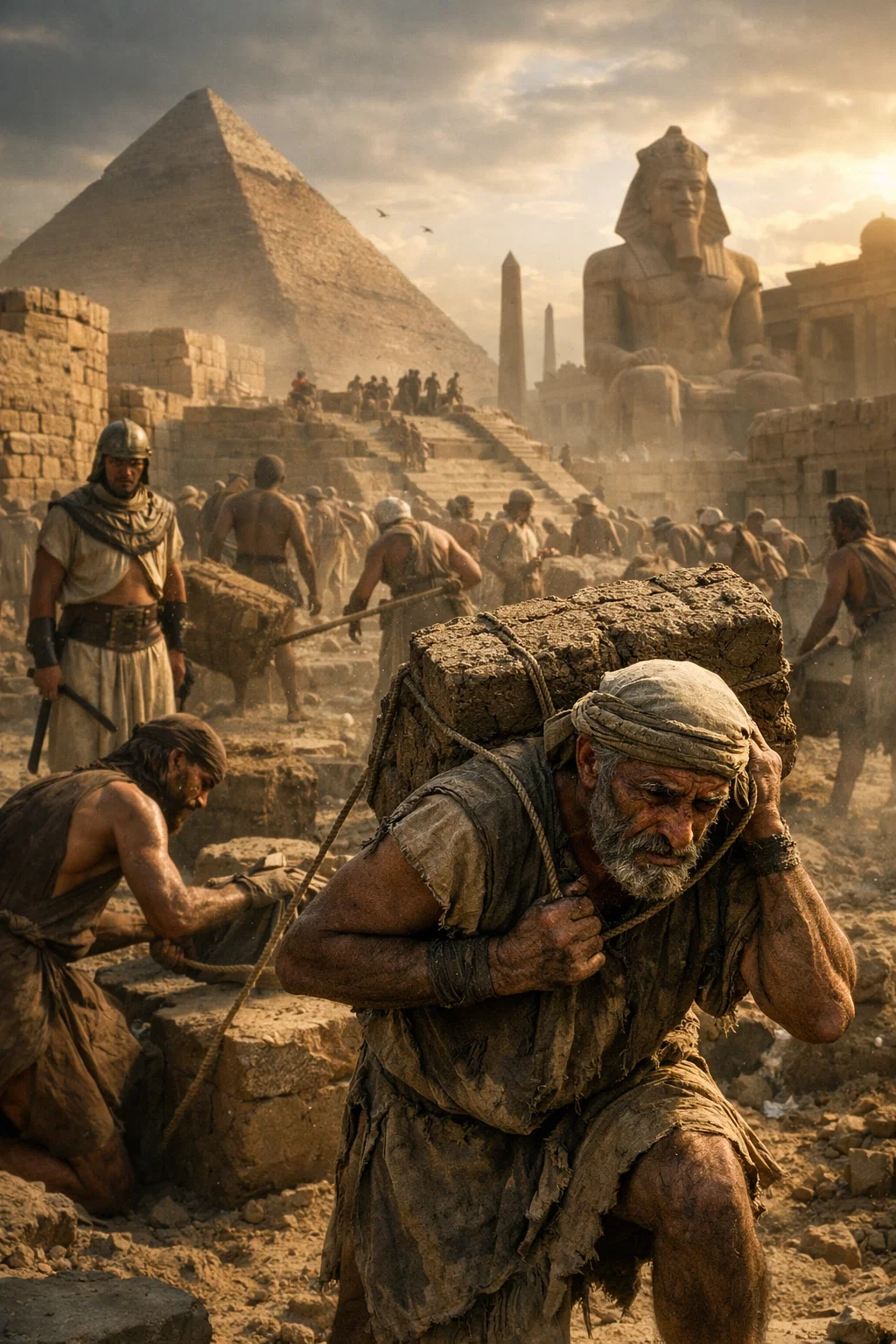
One of the most frequently mentioned themes throughout Scripture is slavery. Not because slavery itself is the main focus, but because the central point is the liberation from slavery.
All concepts in this existence are based on duality — light and darkness, heaven and earth, day and night — and even Adam understood reality through opposites after eating from the Tree of Knowledge of Good and Evil. We know what is bad because we know what is good; we know cruelty because we know compassion, beauty because we know ugliness.
Likewise, the biblical story teaches what freedom is by showing what slavery is. The children of Israel had to experience slavery in order to understand freedom. Many say that one cannot truly know freedom unless one has first lost it.
The Meaning of “Mitzraim”
Mitzraim (מִצְרָיְם) was a son of Ham (Genesis 10:6) and is the Hebrew word used for Egypt. But, as with many Hebrew words, it contains a deeper meaning that reveals the biblical understanding of slavery and, consequently, freedom.
The ending “-im” indicates a plural form. The singular form would be matzor (מָצוֹר), which appears in places like Isaiah 37:25:
I dug and drank the waters; with the soles of my feet I dried up all the rivers of Egypt (matzor).
A matzor in Hebrew signifies a siege — when an army encircles a city to cut off supplies.
That word comes from the root tzar (צָר), meaning narrow or constricted, connected with pressure and suffering. The word tzorer, often translated as “enemy,” literally means “one who causes suffering.”
Another related word is tzur (צוּר), one of the Hebrew words for rock. In the Psalms, David calls Yehovah his rock. This word also comes from the idea of pressure — something formed under great compression deep within the earth.
Reflection on the Concept of Slavery
With this linguistic background, we can reflect on where the children of Israel were when they suffered under slavery in Mitzraim, Egypt. Suffering was not only physical — it was also mental and emotional. Living in this world, we realize that our strongest chains often exist in the mind. Anxiety, worry, and internal pressure make us feel as though we’re in a narrow place. Though we may have left physical Egypt and slavery, how many of us can say we are truly free in our minds?
This truth is something Yeshua taught when he said:
“Come to me, all you who are weary and burdened, and I will give you rest…”
Matthew 11:28-29 (translated)
Mitzraim (מִצְרָיְם) was one of the sons of Ham (Gen 10:6), and it is the Hebrew word for Egypt.